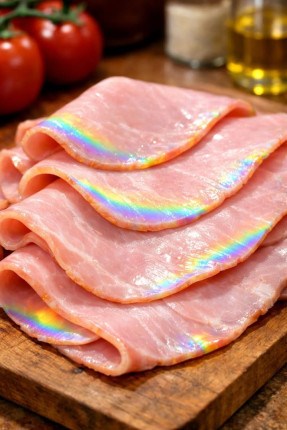
Spoiled deli meat shows very different signs, and they’re usually hard to miss.
### Signs of Spoiled Ham (Not Iridescence)
* A sour, rotten, or sulfur-like smell
* A thick, sticky slime that doesn’t rinse away
* Gray, green, or brown discoloration that doesn’t change with light
* Mold (white, green, or black fuzzy spots)
* A strong ammonia-like odor
A rainbow shine that **changes or disappears when you tilt the slice** is not on that list.
—
## Why the Shine Looks Worse in the Fridge
Many people only notice iridescence right after opening the fridge—and that’s not a coincidence.
Refrigerator lighting (especially LED or fluorescent bulbs) creates the perfect conditions for this effect. Cold temperatures also increase surface moisture, which enhances light reflection.
In warmer or softer lighting, the shine may vanish completely.
—
No.
Some people worry that the shimmer is caused by nitrates, nitrites, or other curing agents used in deli meats. While curing affects the pink color of ham, **it does not create iridescence**.
The effect appears in:
* Cured meats
* Uncured meats
* Fresh cuts of beef or turkey
* Even cooked roast meats sliced thinly
It’s about structure and light—not additives.
—
## Why Thinly Sliced Deli Meat Shows It More
Commercial deli slicers cut meat into ultra-thin, uniform slices. This exposes a large, smooth surface of muscle fibers aligned in the same direction. When light hits that surface, it reflects unevenly, creating the rainbow effect.
Thicker, hand-cut pieces tend to scatter light instead, so you’re less likely to see the shimmer.
Ironically, **higher-quality, more precisely sliced meat is more likely to look iridescent**.
—
## What About the “Oily” or “Metallic” Look?
Some people describe the shine as greasy or metallic. That’s understandable—but misleading.
The sheen isn’t oil separating or metal contamination. It’s light reflecting off:
* Moisture on the surface
* Natural fats in the meat
* Protein structures beneath the surface
If the ham actually *is* oily or greasy to the touch and smells off, that’s different. But visual “oil slick” colors alone aren’t a problem.
—
## How to Tell Iridescence From Actual Color Changes
Here’s a simple trick:
### The Tilt Test
* Hold the slice under a light
* Slowly tilt it back and forth
If:
* The colors shift or disappear → **Normal iridescence**
* The color stays green/gray regardless of angle → **Possible spoilage**
True spoilage changes the meat itself. Iridescence changes only how the meat *looks* under light.
—
## How Long Is Deli Ham Safe After Opening?
Even if the ham looks fine, time still matters.
General guidelines:
* **Unopened deli ham:** Follow the “use by” date
* **Opened deli ham:** 3–5 days in the refrigerator
Always store it:
* In an airtight container
* At or below 40°F (4°C)
* Away from excess moisture
If it’s been open longer than recommended, it’s safer to discard it—even if it looks okay.
—
## Can Bacteria Ever Cause a Shimmer?
Not in this way.
Bacteria that spoil meat cause:
* Texture changes
* Odors
* Sticky residue
* Dull or murky colors
They don’t create clean, shifting rainbow patterns. If bacteria are the issue, your nose and fingers will tell you long before your eyes do.
—
## Why This Freaks People Out (And That’s Normal)
Humans are wired to avoid strange-looking food. Unusual colors trigger caution for a good reason—it kept our ancestors alive.
But modern food science sometimes clashes with instinct.
The rainbow sheen feels unnatural because we don’t expect meat to behave like a CD or soap bubble. Once you know it’s a harmless optical illusion, it becomes far less alarming.
—
## When You Should Trust Your Instincts and Toss It Anyway
Even with all the science, one rule always applies:
If you’re uncomfortable eating it, don’t.
Food safety isn’t just about rules—it’s about confidence and peace of mind. If something smells off, feels wrong, or simply makes you uneasy, throwing it away is the right call.
—
## Common Myths About Rainbow Deli Meat
**Myth:** It means the meat is fake
**Truth:** It happens in natural muscle tissue
**Myth:** It’s a sign of chemicals
**Truth:** It’s caused by light diffraction
**Myth:** It means the meat is old
**Truth:** Fresh meat can show it too
—
## Final Thoughts
Finding a rainbow-like shine on deli ham can be surprising, even unsettling—but in most cases, it’s **completely normal and harmless**. It’s a visual trick caused by light interacting with thinly sliced muscle fibers, not a sign of spoilage or contamination.
As long as your ham:
* Smells normal
* Feels normal
* Is within its safe storage window
That shimmering slice is safe to eat.
So the next time you see that rainbow flash in your fridge, you can relax. It’s not bacteria—it’s just a little unexpected physics sneaking into your sandwich.
