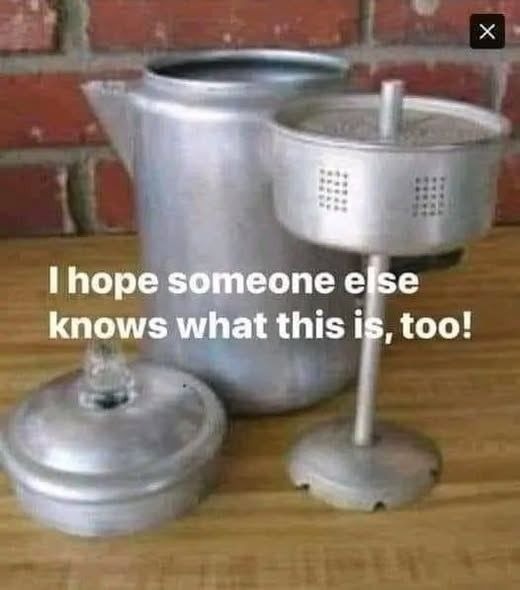
Made mostly of stainless steel or aluminum, the classic stovetop or electric percolator looks like something designed by an engineer who assumed you knew what you were doing. Inside, there’s a hollow tube, a metal basket, and a lid crowned with a tiny glass dome—the percolator’s only concession to transparency.
That glass knob is crucial. It’s how you *watch* the coffee. And watching is half the ritual.
Coffee doesn’t just appear. It *emerges*.
—
## The Soundtrack of Mornings Past
If you grew up around a percolator, you remember the sound.
First, silence. Then a faint gurgle. Then a rhythmic *perk… perk… perk* that slowly builds confidence. That sound wasn’t background noise—it was a signal. Coffee is happening. Something important is underway.
In my grandmother’s kitchen, that sound meant the day had officially begun. Before news channels murmured from TVs, before phones buzzed, before calendars ruled our lives, there was the percolator, announcing itself like a town crier.
That sound carried information. Too fast? The coffee would be bitter. Too slow? Weak. Just right? You’d know—because you learned. You paid attention.
You couldn’t walk away and scroll your phone. The percolator demanded presence.
## Brewing as Performance Art
Making coffee with a percolator isn’t convenient. It’s theatrical.
You measure grounds by instinct, not grams. You pour water based on experience. You assemble the parts with care, aligning everything just so. Then you wait, watching the amber liquid bubble up into the glass dome, spill back down, and repeat the cycle over and over.
This is extraction by persistence.
Modern methods try to avoid over-extraction at all costs. The percolator laughs at this anxiety. It extracts until you stop it. It assumes you know when enough is enough.
There’s something deeply human about that.
You don’t outsource judgment to a machine. You make a call. You trust yourself. And if you screw it up, you drink it anyway—because that’s what adults do.
## Why the Percolator Fell Out of Favor
Let’s be honest: the percolator is not subtle.
It makes strong coffee. Sometimes aggressively strong. It can scorch beans, boil flavors away, and turn delicate roasts into something resembling motor oil if mishandled.
As coffee culture shifted toward nuance—single-origin beans, precise temperatures, bloom times measured in seconds—the percolator became a blunt instrument. It didn’t care where your beans were from. It treated all coffee equally and relentlessly.
Convenience also played a role. Drip machines promised consistency. Pods promised speed. Espresso machines promised café vibes without human error.
The percolator promised none of that.
It required time. Attention. Patience. And a willingness to accept imperfection.
So it was quietly pushed aside, relegated to cabins, basements, and grandmothers’ kitchens.
—
## The Myth of “Better” Coffee
Here’s the uncomfortable truth: “better” coffee is often just coffee that fits our current lifestyle.
We like control. We like predictability. We like pressing a button and trusting that an algorithm has our back.
But the percolator comes from a time when mornings were slower and rituals mattered more than optimization. Coffee wasn’t just fuel; it was an event. A reason to sit. To talk. To pause before the day took over.
My grandmother didn’t rush her coffee. She poured it into thick ceramic mugs that retained heat and memory. She drank it at the table, not in the car. The percolator wasn’t just a tool—it was a centerpiece.
It shaped the rhythm of the room.
—
## The Confidence of Old Things
There’s a quiet confidence in vintage appliances.
The percolator doesn’t try to impress you. It doesn’t rebrand itself every year. It doesn’t need updates. It was built to last, not to sell accessories.
Many of them are still working decades later, scars and all. Scratches, dents, heat stains—each mark evidence of use, not failure.
In a world where devices feel disposable, the percolator’s longevity feels radical.
It says: *Learn me. Respect me. I’ll serve you for life.*
—
## Brewing Coffee, Brewing Memory
When I finally convinced my grandmother to show me how to use it, she didn’t give me instructions. She gave me stories.
She talked about early mornings with my grandfather. About neighbors stopping by unannounced. About conversations that started with coffee and ended hours later.
The percolator had been present for all of it. It wasn’t background—it was infrastructure.
As the coffee perked, she lifted the lid slightly, peered inside, and nodded.
“Almost,” she said.
Almost what? Perfect? Ready? Right?
She didn’t explain. She didn’t have to.
—
## Trying It Yourself in the Modern World
Using a percolator today feels rebellious.
It’s slower. It’s louder. It doesn’t care about your schedule. But that’s exactly why it’s worth revisiting.
In a time when everything is optimized, automated, and accelerated, the percolator asks you to slow down and participate. To be present. To accept that not everything needs to be perfect to be meaningful.
You might overbrew it. You might underbrew it. You’ll definitely make a mess the first time.
And then, one morning, you’ll get it right—not because a machine told you, but because *you knew*.
—
## The Vintage Brew Master Lives On
The coffee percolator isn’t obsolete. It’s just misunderstood.
It belongs to a different philosophy—one that values ritual over speed, involvement over convenience, and experience over efficiency. It reminds us that some things are better when they take a little effort.
When I packed up my grandmother’s kitchen after she passed, I almost left the percolator behind. It felt heavy. Old. Inconvenient.
But I took it.
Now it sits on my shelf, waiting. And every once in a while, when the morning feels too rushed or the world too loud, I pull it down. I fill it. I listen. I watch the glass knob bloom with coffee.
And for a moment, time perks a little slower.
—
If you want, I can:
* tighten this into a more polished literary essay
* add humor and sarcasm
* turn it into a Substack-style personal piece
* or lean harder into coffee history and mechanics
Just say the word ☕
