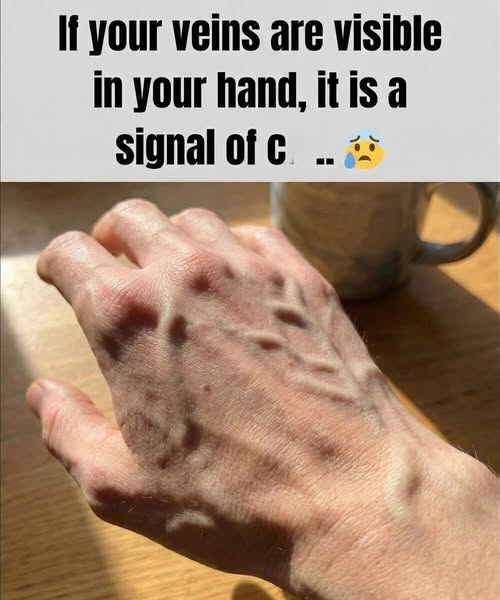
Some people naturally have:
* Thinner skin
* Less subcutaneous fat
* More superficial veins
—
### **2. Low Body Fat**
Fat sits between the skin and the veins. When body fat decreases — due to weight loss, athletic training, or natural body composition — veins become easier to see.
This is why:
* Athletes often have prominent veins
* Veins may appear after weight loss
* Muscular arms and legs show more vascular detail
This is **not dangerous by itself**.
—
### **3. Exercise and Muscle Pump**
* Muscles demand more oxygen
* Blood flow increases
* Veins temporarily expand
This causes veins to appear larger and more defined — a phenomenon often called a *“pump.”*
After rest, veins usually return to normal size.
—
### **4. Heat and Temperature Changes**
Warm temperatures cause blood vessels to **dilate**, pushing veins closer to the skin.
You may notice more visible veins:
This is a **normal thermoregulation response**.
—
### **5. Aging**
As we age:
* Skin becomes thinner
* Fat layers decrease
* Veins lose elasticity
This makes veins more noticeable, especially on:
* Hands
* Arms
* Feet
This is a **normal part of aging**, not a disease.
—
### **6. Pregnancy**
Pregnancy increases:
* Blood volume
* Pressure on pelvic veins
* Hormonal changes
These factors can cause visible veins, especially in the legs and abdomen. In most cases, this improves after delivery.
—
## **When Visible Veins Might Signal a Health Issue**
While most visible veins are harmless, **certain patterns or symptoms** can indicate underlying problems.
### **1. Varicose Veins**
Varicose veins are:
* Enlarged
* Twisted
* Often blue or purple
* Usually found in the legs
They occur when vein valves weaken, allowing blood to pool.
**Symptoms may include:**
* Aching or heaviness
* Swelling
* Burning or throbbing
* Itching around veins
Varicose veins are common and usually not dangerous — but they can cause discomfort and complications if untreated.
—
### **2. Chronic Venous Insufficiency (CVI)**
This condition occurs when veins struggle to return blood to the heart.
**Warning signs include:**
* Persistent leg swelling
* Skin discoloration near ankles
* Thickened or leathery skin
* Leg pain that worsens with standing
* Slow-healing wounds or ulcers
CVI requires medical evaluation and treatment.
—
### **3. Sudden Vein Changes**
A **sudden appearance of prominent veins**, especially if one-sided, can be a red flag.
Seek medical attention if visible veins appear suddenly along with:
* Pain
* Swelling
* Redness
* Warmth
This could indicate inflammation or a blood clot.
—
### **4. Superficial Thrombophlebitis**
This is inflammation and clotting in a superficial vein.
Symptoms include:
* Hard, rope-like vein
* Tenderness
* Redness along the vein path
While often not life-threatening, it should be evaluated by a healthcare provider.
—
### **5. Signs of Circulatory or Heart Issues**
In rare cases, visible veins combined with other symptoms may point to systemic problems.
Be cautious if visible veins are accompanied by:
* Shortness of breath
* Chest pain
* Fatigue
* Dizziness
* Unexplained swelling
These symptoms warrant **immediate medical attention**.
—
## **Visible Veins and Skin Tone: A Note on Color**
Veins may appear:
* Blue
* Green
* Purple
This is due to how light penetrates skin — **not the color of the blood** (which is always red).
Skin tone, thickness, and lighting all affect how veins appear.
—
## **Are Visible Veins Ever Dangerous on Their Own?**
In most cases, **no**.
Visible veins alone — without pain, swelling, or other symptoms — are usually a cosmetic or anatomical issue, not a medical one.
However, context matters. The **pattern, timing, location, and associated symptoms** tell the real story.
—
## **When Should You See a Doctor?**
You should consider medical evaluation if:
* Veins suddenly become prominent
* One limb looks significantly different from the other
* Veins are painful, warm, or red
* You experience swelling that doesn’t go down
* Skin changes or ulcers develop
* You have a personal or family history of blood clots
* Visible veins are accompanied by systemic symptoms
Trust your instincts — sudden changes deserve attention.
—
## **Can You Reduce Visible Veins?**
If visible veins are cosmetic and not medical, options include:
### **Lifestyle Adjustments**
* Regular movement and exercise
* Elevating legs when resting
* Maintaining a healthy weight
* Avoiding prolonged sitting or standing
* Wearing compression garments if recommended
### **Medical Treatments**
* Sclerotherapy
* Laser therapy
* Vein ablation procedures
These are typically reserved for symptomatic or bothersome veins and should be discussed with a specialist.
—
## **Myths About Visible Veins**
Let’s clear up a few misconceptions:
**Myth:** Visible veins mean poor circulation
**Truth:** They often indicate efficient blood flow
**Myth:** Veiny arms are unhealthy
**Truth:** They’re common in athletes and lean individuals
**Myth:** All visible veins lead to clots
**Truth:** Most do not
—
## **The Bottom Line**
Visible veins are usually **normal, harmless, and influenced by genetics, age, body composition, and lifestyle**.
They become a concern **only when paired with pain, swelling, skin changes, or sudden onset**.
Instead of panic, think observation.
Your body gives signals — and visible veins are one of them. Most of the time, they’re simply part of how your body adapts, ages, and functions.
If something feels off, get it checked. But if veins have always been visible and nothing else has changed, there’s usually no reason to worry.
—
If you’d like, I can:
* Rewrite this in a **more viral or click-style headline format**
* Add **medical citations**
* Shorten it for **health or lifestyle blogs**
* Adapt it for **SEO optimization**
Just tell me what you want next.
